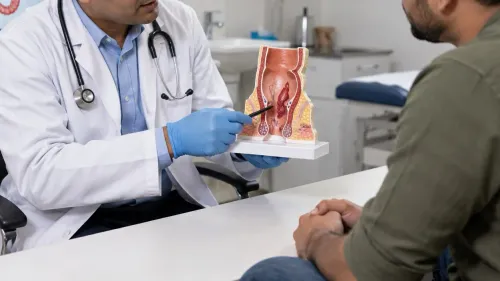
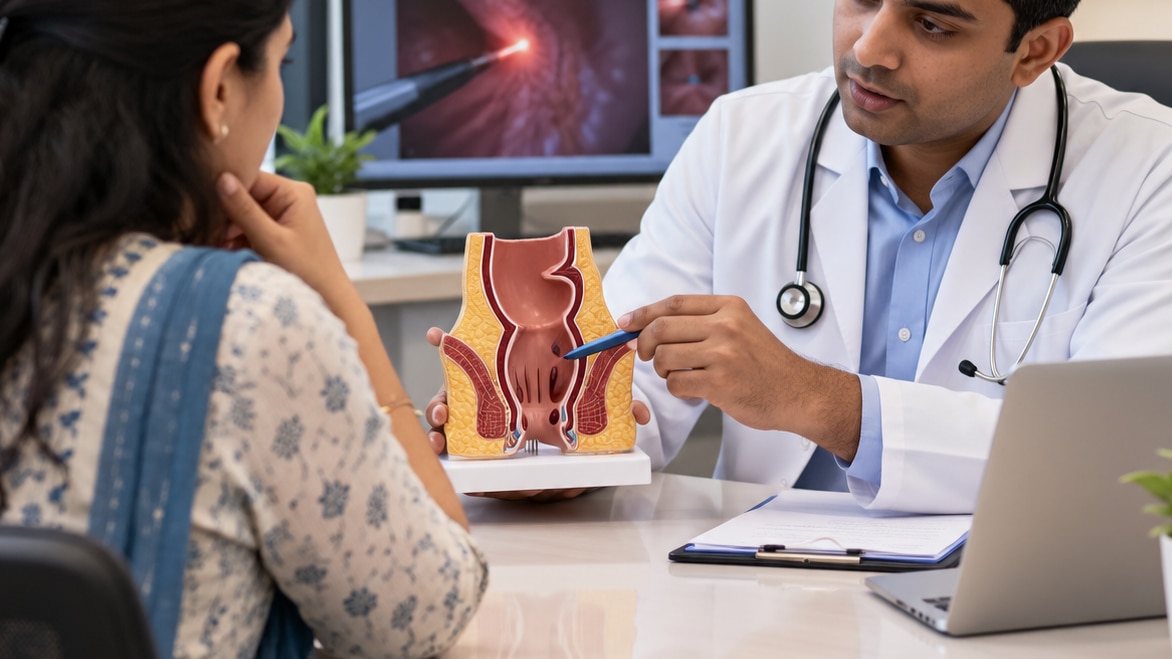
Before consenting to treatment, you need more than a promise of less pain or a quick recovery. Ask questions that establish the diagnosis, identify the exact procedure, expose its limits and risks, and give you a concrete plan for medicines, bowel movements, emergencies and follow-up.
Key takeaways
- Confirm the diagnosis and haemorrhoid grade before choosing laser treatment.
- Ask what the laser will treat and why it suits your haemorrhoids.
- Discuss your surgeon’s experience, personal risks and possible complications.
- Get clear instructions for preparation, recovery, follow-up and urgent warning signs.
Has the diagnosis and haemorrhoid grade been confirmed?
Confirm the haemorrhoid diagnosis before discussing a laser procedure. Ask, “Have you examined my anus and rectum, and what grade are the haemorrhoids?” The examination must distinguish internal and external piles from an anal fissure, fistula, abscess, polyp, inflammatory bowel disease or evidence of colorectal cancer.
| Finding | What it means | Question to ask |
|---|---|---|
| Grade I to IV haemorrhoids | I stays inside; II protrudes while straining but returns alone; III needs manual replacement; IV remains prolapsed | “Which grade describes mine?” |
| External piles | Swelling lies beneath the skin and may thrombose | “Will the proposed treatment address the external component?” |
| Anoscopy or proctoscopy | Direct inspection of the anal canal and lower rectum | “Was anoscopy and proctoscopy evidence recorded?” |
Ask whether anoscopy or proctoscopy was performed and whether removed tissue will undergo histopathology. Some laser techniques leave no conventional specimen, so an atypical appearance needs a clear diagnostic plan.
Rectal bleeding needs extra scrutiny if you have anaemia, weight loss, altered bowel habits, persistent bleeding, a family history of bowel cancer or overdue age-appropriate screening. Ask whether you need a complete blood count, colonoscopy or another test before surgery. Severe pain may indicate a fissure; haemorrhoid laser treatment does not heal it.
For discharge or recurrent swelling, ask where a fistula’s internal opening and tract lie, whether the sphincter is involved, how continence will be protected and whether MRI is needed.
What exactly will the laser procedure do, and why is it suitable?
“Laser piles surgery” is not one standard operation. Ask the doctor to write the precise name: laser haemorrhoidoplasty, laser haemorrhoid ablation, laser-assisted haemorrhoidectomy, haemorrhoidal-artery treatment or another technique.
Ask these questions before consenting:
- What will the laser do: shrink tissue, coagulate blood vessels, seal tissue or remove part of the haemorrhoid?
- Does it treat bleeding, prolapse, external tissue, or only internal haemorrhoids?
- Why does it suit my grade, size, location and symptoms better than the alternatives?
- What will remain if large external piles, prominent skin, mixed internal-external disease or significant prolapse is not removed?
- Could I need staged treatment or later excision?
| Option | What it does | Main limitation or use |
|---|---|---|
| Laser haemorrhoidoplasty or ablation | Shrinks or coagulates selected internal haemorrhoidal tissue | May leave prolapse or require retreatment |
| Rubber-band ligation, sclerotherapy or infrared coagulation | Treats bleeding internal haemorrhoids without major tissue removal | Suits smaller internal disease, not substantial external components |
| Haemorrhoidal-artery treatment | Reduces arterial blood flow to internal haemorrhoids | Does not remove prominent external tissue |
| Excisional haemorrhoidectomy | Removes haemorrhoidal tissue and external components | More wound healing and recovery, but addresses larger prolapse |
Large grade III or IV prolapse and thrombosed external haemorrhoids often need a different approach. Active infection, uncontrolled bleeding or another diagnosis warrants postponing laser treatment. A consultation with Dr Gowri Singh-Best Laser Piles Surgeon in Pune should explain these trade-offs for your anatomy, not rely on the word “laser.”
Related service
Laser Piles Surgeon in Pune Laser Piles Surgeon in Viman Nagar, Kharadi, Vishrantwadi, Pune Dr Gowri Singh is the Best Laser Piles Surgeon in Pune, specializing as a Piles Surgeon, Laser Piles Doctor, and Lady Piles Surgeon in Viman Nagar,... View service → |
Who will perform the operation, and what risks apply to my case?
Ask who will perform the operation: request the surgeon’s colorectal or general-surgery training, hospital privileges, experience with the named technique and the number performed each year. Confirm who will conduct it, who will administer anaesthesia for piles surgery, and which hospital or emergency service will manage a complication.
Request the surgeon complication rate, haemorrhoid recurrence rate and reintervention rate for your grade and procedure. Reject “best” or “risk-free” claims without numbers. Before signing consent, ask whether removed tissue will undergo histopathology and which findings would change the plan.
- Ask the doctor to separate common short-term effects from urgent laser piles surgery risks: postoperative pain, minor bleeding and temporary urinary difficulty versus heavy bleeding, infection, thrombosis, urinary retention, worsening prolapse, anal stenosis, faecal urgency or incontinence.
- Ask whether laser treatment’s smaller wound trades less early pain for more residual tissue or later retreatment than excisional haemorrhoidectomy.
| Technique | What it does | What to ask |
|---|---|---|
| Laser haemorrhoidoplasty or ablation | Shrinks or coagulates selected internal tissue | Does it treat external piles and prolapse, and what are the retreatment figures? |
| Excisional haemorrhoidectomy | Removes haemorrhoidal tissue | How do its pain, healing and recurrence rates compare? |
| Stapled haemorrhoidopexy | Lifts internal mucosa; it does not remove external haemorrhoids | How do recurrence and rare pelvic complications compare with other options? |
What must I do before surgery?
Get written, procedure-specific instructions before you consent: food, drink, bowel preparation, transport, work, and medicines before piles surgery. Confirm the planned anaesthetic, day-surgery or admission arrangements, fasting time, expected escort, and hospital contact number.
1. Give the surgeon and prescribing clinician a complete list of anticoagulants, antiplatelet drugs, NSAIDs such as ibuprofen, diabetes medicines, vitamins, and herbal supplements. Never stop an anticoagulant yourself. The interruption and restart schedule for anticoagulants and haemorrhoid surgery depends on the drug, bleeding risk, and reason for treatment.
2. Ask whether a complete blood count or colonoscopy must come first, especially with anaemia or ongoing rectal bleeding. Ask whether a suspected fissure, fistula, or active infection needs treatment before haemorrhoid surgery.
3. Ask what bowel plan starts before the operation and continues afterward. Request exact fibre, fluid, stool-softener, or laxative instructions for fibre and constipation prevention; the procedure does not remove the causes of hard stool or straining. Ask how to limit toilet sitting and what to do if diarrhoea causes irritation.
This checklist must reflect your medicines, bowel habits, and other diagnoses, not a generic leaflet.
What will recovery and follow-up look like, and when is help urgent?
Do not accept a generic promise of rapid recovery. Recovery after laser piles surgery depends on the named technique, how much tissue is removed and whether another anal condition is treated.
1. Ask for a day-by-day timetable covering expected pain, the first bowel movement, bleeding or discharge, return to work, driving, exercise, sexual activity and the first review. Ask how recovery differs when tissue is ablated rather than excised, and whether a fissure or fistula will lengthen it.
2. Obtain the surgeon’s emergency number and the hospital to use after discharge. Confirm that heavy or persistent postoperative bleeding, dizziness or fainting, fever, worsening pain, inability to urinate and progressive swelling are piles surgery emergency symptoms, not routine recovery.
3. Ask when haemorrhoid surgery follow-up occurs, how the doctor will check residual prolapse or recurrence, and what happens if symptoms remain. Request recurrence and reintervention rates for your haemorrhoid grade, plus the next step if laser treatment fails.
4. Ask how fibre, fluids, constipation treatment, limited toilet sitting and avoidance of straining will be monitored. Confirm whether treatment might be staged and who will review you if pathology, bleeding or unexpected symptoms change the diagnosis.
Leave with written discharge instructions, including warning thresholds, rather than relying on verbal reassurance.
Frequently asked questions
How do I confirm that I have haemorrhoids before laser surgery?
Ask the doctor whether they examined your anus and rectum and identified the haemorrhoid type and grade. The examination should distinguish piles from an anal fissure, fistula, abscess, polyp, inflammatory bowel disease or possible colorectal cancer.
What should I ask about the laser procedure itself?
Ask what the laser will do to your haemorrhoids, which symptoms it is intended to treat and why the procedure suits your diagnosis and haemorrhoid grade.
What should I know about the surgeon and risks?
Ask who will perform the operation, their experience with the procedure and which risks apply to your case. Discuss possible complications and what would happen if the treatment does not resolve your symptoms.
What must I do before laser piles surgery?
Ask for specific instructions about food and drink, medicines such as blood thinners, bowel preparation, transport home and the time you need away from work or normal activities.
What will recovery and follow-up involve?
Ask about expected pain, bleeding, bowel movements, wound care, activity restrictions, review appointments and the symptoms that require urgent medical help.