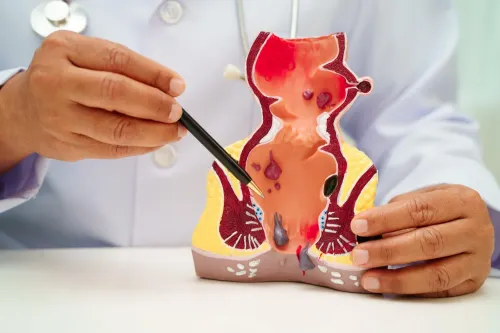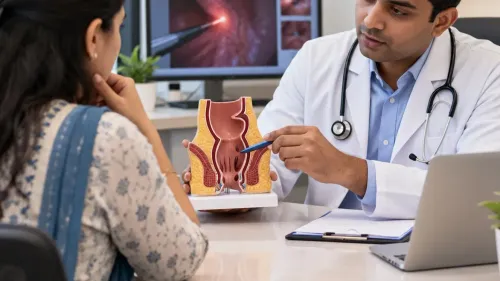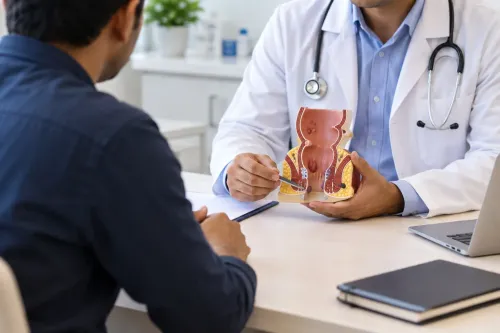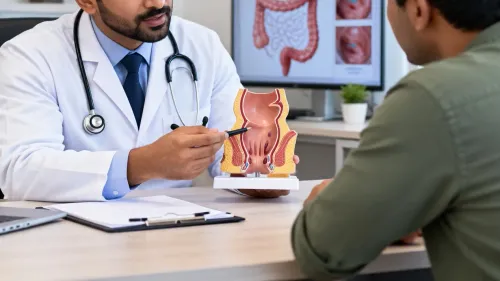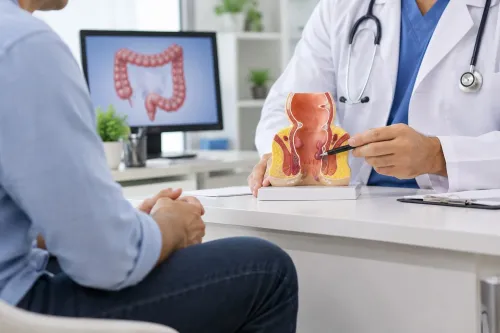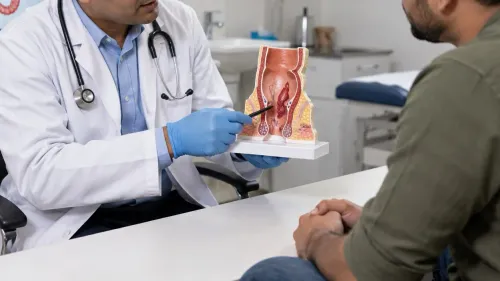
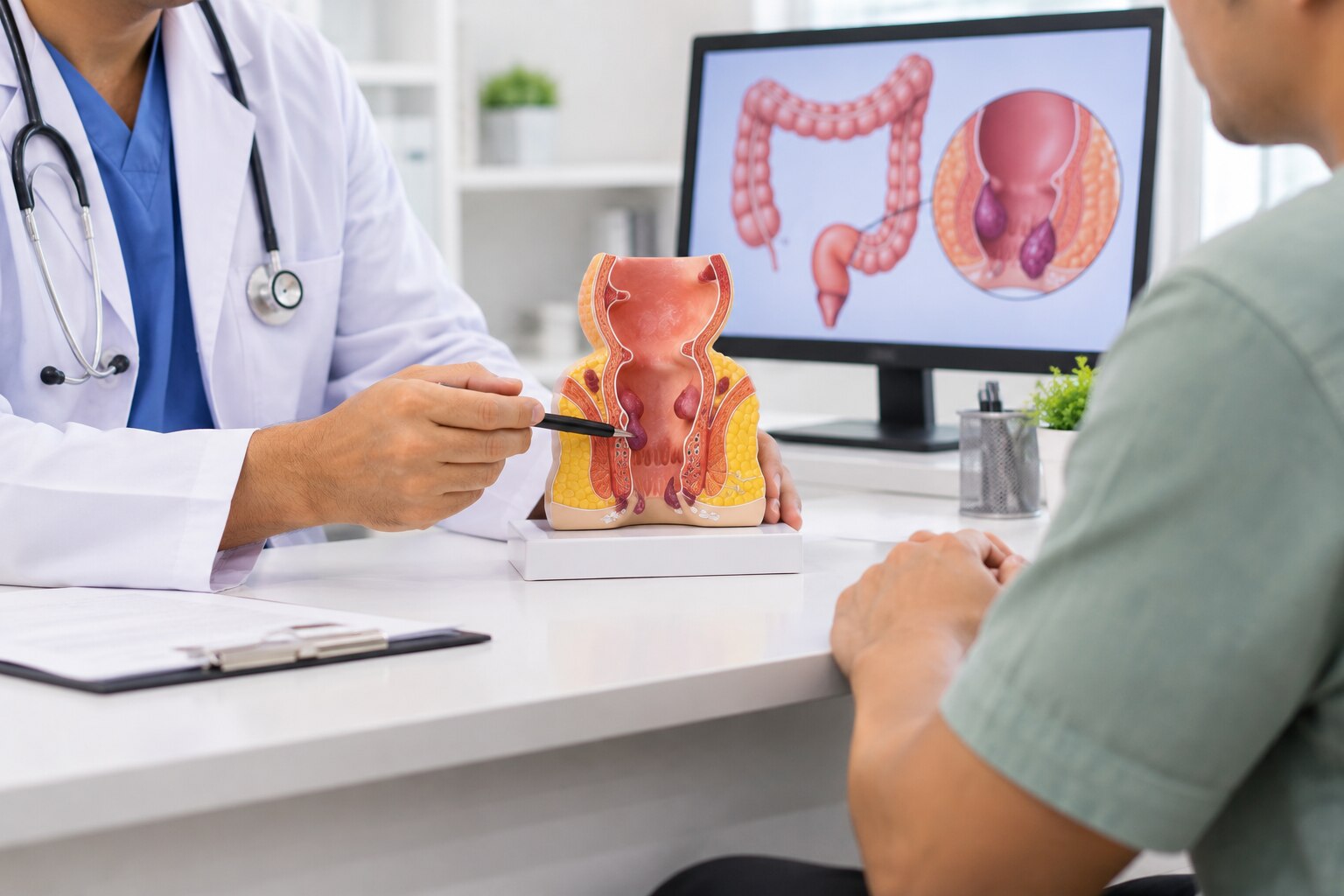
A small amount of bright-red bleeding after constipation is not judged the same way as repeated bleeding, a growing lump or tissue that stays outside the anus. You will be able to match your symptoms to the right level of action, understand what an examination checks, and compare when bowel-habit changes, an office procedure or surgery becomes reasonable.
Key takeaways
- Watch brief bleeding only when it stops and you feel well.
- Arrange an examination if bleeding continues, returns or comes with other symptoms.
- Judge prolapse by whether it retracts after straining or needs manual replacement.
- Correct constipation first, then discuss procedures when symptoms persist or worsen.
Bleeding: when brief observation ends and examination begins
A small, isolated episode of painless bright-red blood on toilet paper or the stool can be watched briefly while you correct constipation, increase fibre and stop straining. This approach applies only when the bleeding stops and you feel well.
Arrange a clinical examination for recurrent rectal bleeding, bleeding that increases or persists, or blood with no clear constipation-related trigger. Do not assume every episode is piles bleeding: the amount, timing and pattern matter more than the label.
Treat these as heavy rectal bleeding emergency signs:
- Brisk or continuous bleeding, or blood clots
- Marked weakness, rapid heartbeat, dizziness or fainting
- Black, tarry stool or maroon stool
- Bleeding with severe anal pain or fever
These symptoms can indicate significant blood loss, infection, thrombosis or another bowel condition. Go to emergency care rather than waiting for a routine appointment.
Seek prompt assessment for bleeding that returns after bowel habits improve, even if each episode looks minor. Also arrange review when bleeding occurs with abdominal pain, altered bowel habits, weight loss or unusual fatigue, because piles are not the only cause of rectal bleeding.
A clinician can examine the anal area and decide whether further tests are needed.
Swelling and prolapse: judge what happens after straining
Swelling that settles soon after defecation is less concerning than swelling that persists, enlarges, becomes very painful, prevents sitting, or makes cleaning difficult. Tissue coming out during straining may be prolapsed piles, but the pattern after the bowel movement matters.
The four grades of internal haemorrhoids are grade I, II, III and IV haemorrhoids:
- Grade I bleeds but does not come out.
- Grade II comes out with straining and returns inside on its own.
- Grade III comes out and needs gentle manual replacement.
- Grade IV remains outside and cannot be pushed back.
A grade III prolapse that goes back gently is not automatically an emergency. Do not forcefully push tissue back, especially when piles cannot be pushed back easily. Arrange prompt assessment if the tissue stays outside, becomes dusky or black, or pain escalates; these signs can indicate trapped or strangulated tissue or another anorectal problem.
A hard blue or purple lump at the anal edge with sudden severe pain suggests a thrombosed external haemorrhoid and needs assessment. Severe pain with fever, spreading swelling, or difficulty passing urine also requires prompt medical care. Uncomplicated internal haemorrhoids more often cause painless bleeding or prolapse than constant severe pain.
Persistent swelling, repeated prolapse, or hygiene and sitting problems deserves examination even without an emergency warning sign.
Why a piles diagnosis needs more than a look at the toilet paper
Rectal bleeding causes include more than piles. Anal fissure versus piles matters because a fissure often causes sharp pain during or after defecation, while piles commonly bleed without severe constant pain. Inflammation, polyps, rectal prolapse, colorectal cancer and other bowel disease can also mimic piles.
Fistula and abscess need separate attention: a fistula can cause recurrent swelling, pus or an external opening, while an abscess can cause severe pain, fever and spreading swelling.
A proper assessment follows this sequence:
- Review your bleeding, pain, swelling, bowel habit, medicines and family history, including colorectal cancer.
- Inspect the anus for a fissure, external pile, fistula opening, prolapse, skin changes or swelling.
- Perform a digital rectal examination to assess tenderness, masses, blood and the anal canal.
- Perform an anoscopy examination to view internal piles and the lower rectal lining.
A clinician considers colon evaluation based on your age, screening history, persistent or unexplained bleeding, altered bowel habit, abdominal symptoms, weight loss or iron-deficiency anaemia. This may involve colonoscopy.
Ongoing bleeding or fatigue can prompt a complete blood count and iron studies to check for anaemia. These tests do not replace examination and are not automatically needed for everyone.
When bowel measures are enough—and when a procedure becomes reasonable
When piles treatment is necessary depends on symptoms after immediate danger has been excluded. Start by increasing dietary or supplemental fibre, drinking adequate fluids, avoiding straining and prolonged toilet sitting, and treating constipation or diarrhoea. These measures often improve grade I and II symptoms but do not reliably correct major prolapse.
A procedure becomes reasonable when bleeding continues despite adequate bowel-habit changes, prolapse repeatedly needs manual reduction, discharge or hygiene problems persist, or symptoms limit daily life. The presence of piles alone does not require treatment.
| Option | What it means | When it applies |
|---|---|---|
| Rubber-band ligation | An office procedure for internal piles | Suitable grade I, II and selected grade III piles; it does not treat external skin |
| Excisional haemorrhoidectomy | Removes bulky haemorrhoidal tissue | More definitive for combined internal-external disease or grade III and IV prolapse, but more painful |
| Stapled haemorrhoidopexy | Lifts internal prolapse | Leaves external piles and can recur |
| Artery-locating procedures | Interrupt blood flow to internal piles | May hurt less early but can require further treatment |
A laser piles treatment comparison should include prolapse grade, external tissue, bleeding, pain and examination findings—not the word “laser” alone. Consultation with Dr Gowri Singh-Best Laser Piles Surgeon in Pune can connect those findings to an appropriate option rather than treating the label alone.
Related services
Piles Doctor in Pune Piles Doctor in Viman Nagar, Kharadi, Vishrantwadi, Pune Dr Gowri Singh is the Best Piles Doctor, Laser Piles Surgeon, Laser Piles Doctor, Lady Piles Doctor in Viman Nagar, Kalyani Nagar, Koregaon Park,... View service → |
Laser Piles Surgeon in Pune Laser Piles Surgeon in Viman Nagar, Kharadi, Vishrantwadi, Pune Dr Gowri Singh is the Best Laser Piles Surgeon in Pune, specializing as a Piles Surgeon, Laser Piles Doctor, and Lady Piles Surgeon in Viman Nagar,... View service → |
What to tell the clinician before choosing treatment
A safe piles treatment consultation links the proposed treatment to your symptoms and examination, not to the mere presence of a haemorrhoid. Ask the clinician to explain why an operation is appropriate now and what happens if fibre and bowel-habit changes continue.
| Finding to review | Question to ask |
|---|---|
| Bleeding pattern | Is the bleeding recurrent, increasing, persistent or unexplained? |
| Prolapse grade | Does tissue stay inside, return alone, need manual replacement or remain outside? |
| External component | Will the treatment address external piles, or only internal haemorrhoids? |
| Pain and examination | What did inspection, digital examination and anoscopy show? |
| Bowel measures | What improvement followed fibre, fluids, constipation treatment and reduced straining? |
Report every anticoagulant and antiplatelet medicine, bleeding disorder, immune-suppressing medicine and relevant medical condition. Do not stop aspirin, warfarin, apixaban or another prescribed medicine without the prescriber’s advice. These details alter the timing and bleeding risk of banding or surgery, making anticoagulants and haemorrhoid treatment a decision to coordinate with the prescriber.
A thrombosed external haemorrhoid does not automatically need an operation. Timing, pain severity, examination findings and bleeding risk determine whether local care and analgesia are safer than early excision.
- Seek emergency care for heavy bleeding, faintness, black stool, fever or severe escalating pain.
- Arrange prompt assessment for non-reducible prolapse or recurrent bleeding.
- Book a specialist piles assessment when symptoms persist or impair daily life.
Frequently asked questions
When should brief piles bleeding be examined?
Arrange an examination when bleeding continues, returns, or occurs with other symptoms. Brief observation applies only when a small episode of painless bright-red bleeding stops and you feel well.
How does prolapse severity affect treatment decisions?
Notice what happens after straining: tissue that retracts on its own differs from tissue that needs manual replacement or remains outside. Tell the clinician exactly what you observe.
Why is toilet-paper bleeding not enough to diagnose piles?
Bright-red blood can have causes other than piles. A clinician needs your symptom history and an examination to assess the source and choose safe treatment.
When are bowel measures enough, and when is a procedure reasonable?
Fibre, constipation treatment and avoiding straining can settle mild symptoms. Discuss a procedure when symptoms persist, recur, or prolapse and bleeding continue despite bowel measures.