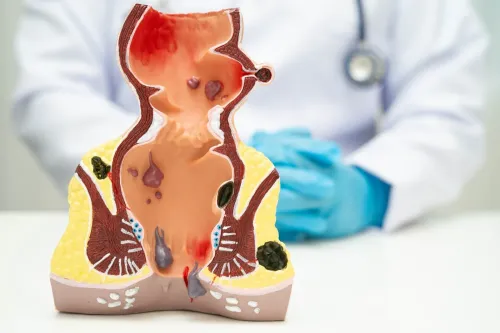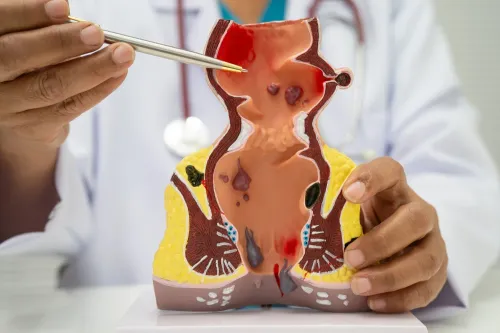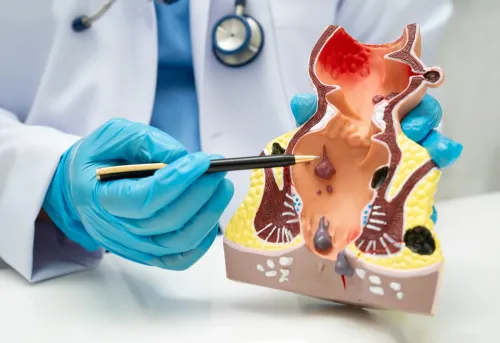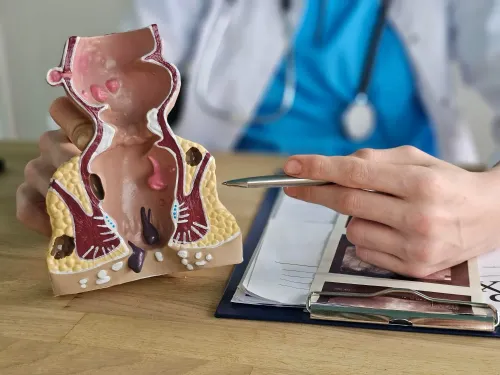
Bright-red bleeding, itching, a lump or tissue coming through the anus can have different causes, and the most visible symptom does not always show how advanced the condition is. By matching symptoms with prolapse grade, warning signs and treatment trade-offs, you can identify when home care is reasonable and what to ask before choosing a procedure.
Key takeaways
- Seek urgent care for heavy bleeding, faintness, fever or rapidly worsening pain.
- Treat constipation and straining before considering procedures for mild haemorrhoids.
- Use prolapse grade and symptom recurrence to guide treatment escalation.
- Laser treatment fits selected internal haemorrhoids, not every anal lump or pain pattern.
Match the Symptom to the Likely Treatment Path
Painless piles bleeding usually comes from an internal haemorrhoid, but new, recurrent or unexplained rectal bleeding still needs clinical assessment. Arrange urgent care for heavy or continuing bleeding, dizziness, fainting, fever, rapidly increasing anal pain or swelling, or difficulty passing urine.
- Itching and swelling: increase fibre and fluids, avoid straining, wash gently, and use a short course of topical treatment if advised. Corticosteroid creams can thin perianal skin when used continuously.
- Prolapse: book an examination, especially when tissue protrudes during bowel movements or needs pushing back. Internal prolapse may respond to rubber-band ligation or another procedure; external haemorrhoids need a different approach.
- A painful anal lump: seek prompt assessment rather than treating it as routine piles. A thrombosed external haemorrhoid, fissure, strangulated prolapse or abscess can cause this symptom.
- Mucus: occasional mucus with prolapse can irritate the skin, but persistent mucus, pus, recurrent swelling or repeated boils near the anus suggests fistula or abscess.
- Difficulty cleaning: prolapsing tissue, mucus or skin tags may trap stool. Gentle washing and drying help temporarily; persistent difficulty warrants examination.
- Pain without a lump: arrange assessment if it persists, because uncomplicated internal haemorrhoids are often painless.
Do not rely on symptom severity alone. A clinician may need to inspect the anus and rectum to separate piles from fissure, abscess, fistula or another bowel condition.
Use Prolapse Grade and Warning Signs to Judge Severity
Prolapse, not pain, determines the grade of internal piles. Start with fibre, adequate fluids, less straining and shorter toilet sitting for mild symptoms; advanced prolapse needs an examination because fibre rarely pulls it back in.
| Grade | Prolapse pattern | Treatment implication |
|---|---|---|
| Grade I piles | Bleed but do not prolapse | Bowel-habit treatment often comes first; office treatment is considered if bleeding continues. |
| Grade II piles | Prolapse during straining, then return by themselves | Rubber-band ligation can suit persistent bleeding or prolapse. |
| Grade III piles | Prolapse and need manual reduction | Office treatment may suit selected cases, but substantial prolapse may need surgery. |
| Grade IV piles | Remain outside and cannot be reduced | Excisional haemorrhoidectomy is often considered, especially with large external or combined disease. |
Get examined when the pattern does not fit uncomplicated internal piles:
- A painful lump at the anal edge suggests a thrombosed external haemorrhoid, fissure, strangulated prolapse or abscess rather than simple internal piles.
- Fever, pus, spreading redness or steadily worsening pain points to an abscess or fistula and needs prompt care.
- Persistent bleeding, dark or mixed-in stool, weight loss, anaemia, a new bowel-habit change or abdominal symptoms require assessment for inflammatory bowel disease or colorectal cancer.
- Mucus, incomplete emptying or a mass that protrudes in a cylindrical ring can indicate rectal prolapse rather than haemorrhoids.
Try Bowel-Habit Treatment Before Escalating Care
For mild bleeding, itching, or a small reducible lump, try bowel-habit treatment for two to four weeks before escalating care. The aim is soft, formed stools that pass without pressure.
| Measure | How to use it | Sign it is working |
|---|---|---|
| Fibre for piles | Aim for about 25–30 g daily from vegetables, fruit, beans, whole grains, or a fibre supplement. Increase gradually to limit gas. | Stools become softer and easier to pass; bleeding and straining decrease. |
| Fluids and stool softeners | Drink enough fluid to keep urine pale, unless a clinician has restricted your intake. Ask a pharmacist or clinician about a stool softener or osmotic laxative if constipation persists. | You pass stool without pushing or hard pellets. |
| Avoid straining | Go when you feel the urge, keep toilet sitting brief, and do not read or use your phone there. | Less pressure, swelling, and prolapse during bowel movements. |
| Sitz bath | Sit in comfortably warm water for 10–15 minutes after bowel movements or when irritated; avoid very hot water. | Itching, soreness, and muscle spasm settle temporarily. |
Continue the changes while symptoms improve, then keep the fibre and toilet habits that prevent relapse. Arrange an examination if bleeding continues after two to four weeks, returns repeatedly, or comes with weight loss, altered bowel habits, or anemia.
Seek prompt care for severe pain, a blue lump, fever, or a prolapse that will not go back inside.
Compare Office Procedures and Surgery by Their Trade-Offs
A treatment that controls bleeding is not necessarily the one that fixes prolapse. Compare the target, recovery and recurrence risk before choosing.
| Option | Main trade-off | Best fit or limitation |
|---|---|---|
| Prescription creams | Reduce itching, irritation or inflammation; they do not remove a prolapsing pile. Prolonged steroid use can thin skin. | Short-term symptom relief after examination. |
| Stool-softening treatment | Fibre, fluids and a stool softener reduce straining, but improvement takes time and does not shrink advanced prolapse. | First-line support for hard stools, bleeding and mild symptoms. |
| Rubber-band ligation | Quick office treatment with little downtime; incorrect placement below the dentate line causes severe pain. | Bleeding or prolapsing internal Grade I–II piles and selected Grade III cases; not external haemorrhoids. |
| Sclerotherapy for haemorrhoids | An injected solution reduces bleeding with limited recovery, but repeat treatment is common. | Smaller bleeding internal piles. |
| Infrared coagulation | Heat seals small bleeding vessels, with minimal disruption; it is less suitable for substantial prolapse. | Early internal piles needing bleeding control. |
| Doppler-guided haemorrhoid treatment | Locates feeding arteries for ligation, with or without lifting prolapsed tissue; recurrence remains possible. | Selected internal piles when preserving tissue matters. |
| Laser procedures | Usually cause less early wound discomfort than excision, but results depend on pile size and technique; external disease remains untreated. | Selected internal haemorrhoids after confirming the method offered. |
| Conventional haemorrhoidectomy | Removes substantial disease most definitively, but causes more pain and a longer recovery. | Large external components, combined disease, or Grade III–IV prolapse. |
A surgeon should also explain whether repeated office sessions, recurrence or recovery time matters most for your pattern. Laparoscopic surgery is not routine for ordinary piles.
Decide Whether Laser Treatment Fits Your Haemorrhoid Pattern
Laser piles treatment usually targets enlarged internal haemorrhoidal cushions. A fibre delivers heat beneath the mucosa, reducing blood flow and shrinking the tissue; it does not remove every external lump or repair a fissure, fistula or abscess. Because “laser” describes equipment rather than one standard operation, ask which technique the surgeon plans.
1. Confirm the diagnosis and grade. Laser treatment for Grade II piles may suit bleeding or prolapse that returns inside on its own. Selected Grade III piles may be suitable, but a large external component, combined internal-external disease or fixed Grade IV prolapse often needs excisional haemorrhoidectomy.
2. Ask what the procedure will treat. A laser haemorrhoid procedure may reduce internal swelling, but it will not permanently close a fistula or drain an abscess. Persistent pus, a skin opening, recurrent boils, fever or rapidly increasing pain requires examination before booking.
3. Compare the proposed method with rubber-band ligation, Doppler-guided treatment and conventional surgery. Ask why laser is preferable for your grade, whether more than one session is possible, and what happens if prolapse remains.
4. Confirm anaesthesia, expected bleeding and pain, time away from work, follow-up, recurrence risk and the likely haemorrhoidectomy recovery if laser is unsuitable. Get the total fee and the surgeon’s written diagnosis.
Dr Gowri Singh-Best Laser Piles Surgeon in Pune can help when the consultation distinguishes a treatable internal pattern from an external or non-haemorrhoid problem. A procedure should follow that distinction, not the laser label.
Related services
Piles Doctor in Pune Piles Doctor in Viman Nagar, Kharadi, Vishrantwadi, Pune Dr Gowri Singh is the Best Piles Doctor, Laser Piles Surgeon, Laser Piles Doctor, Lady Piles Doctor in Viman Nagar, Kalyani Nagar, Koregaon Park,... View service → |
Laser Piles Surgeon in Pune Laser Piles Surgeon in Viman Nagar, Kharadi, Vishrantwadi, Pune Dr Gowri Singh is the Best Laser Piles Surgeon in Pune, specializing as a Piles Surgeon, Laser Piles Doctor, and Lady Piles Surgeon in Viman Nagar,... View service → |
Frequently asked questions
Which piles symptoms need urgent medical care?
Arrange urgent care for heavy or continuing bleeding, dizziness, fainting, fever, rapidly increasing anal pain or swelling, or difficulty passing urine.
Should bowel-habit changes come before a piles procedure?
For mild symptoms, address constipation and straining first by improving fibre, fluids and toilet habits. Escalate care when symptoms persist or recur.
How does prolapse grade affect piles treatment?
Prolapse grade describes whether haemorrhoids stay inside, come out during straining, or require manual replacement. Increasing prolapse and recurrent symptoms can shift treatment from home measures to procedures or surgery.
Is laser treatment suitable for every haemorrhoid?
No. Laser treatment is considered for selected internal haemorrhoids after examination. External lumps, severe prolapse and other causes of anal pain may require a different approach.