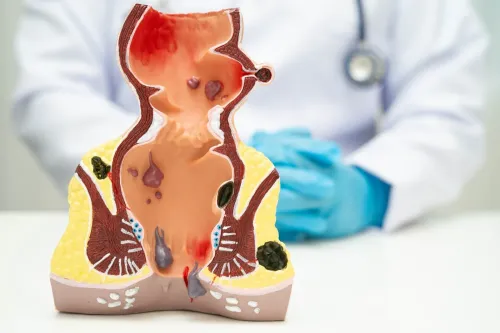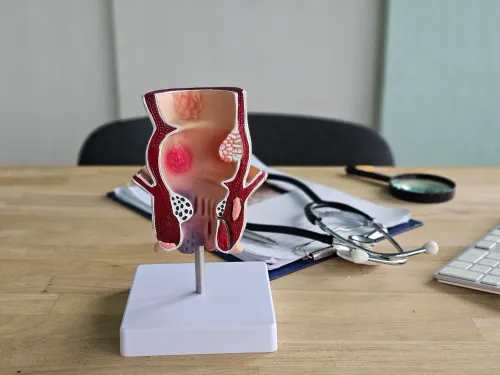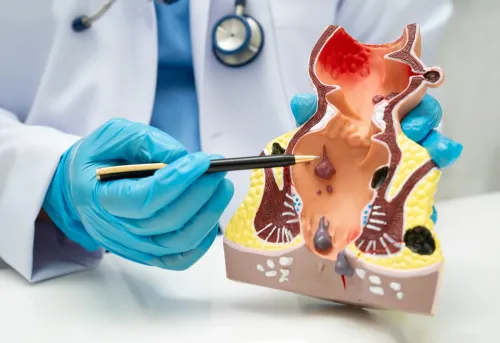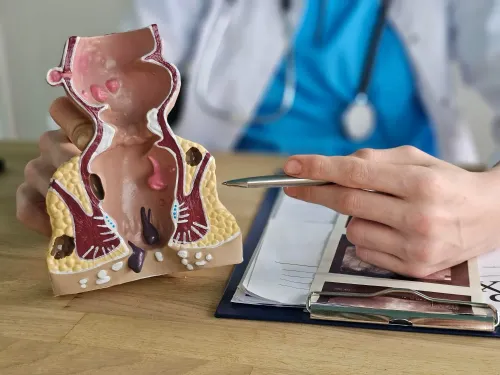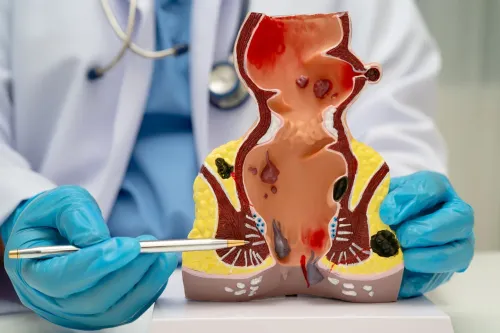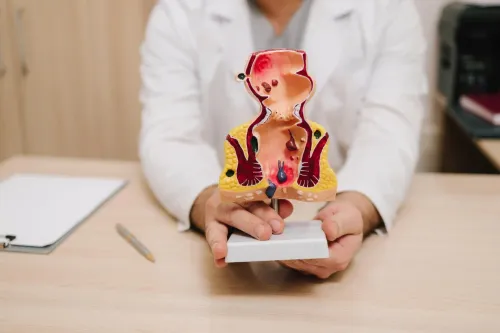
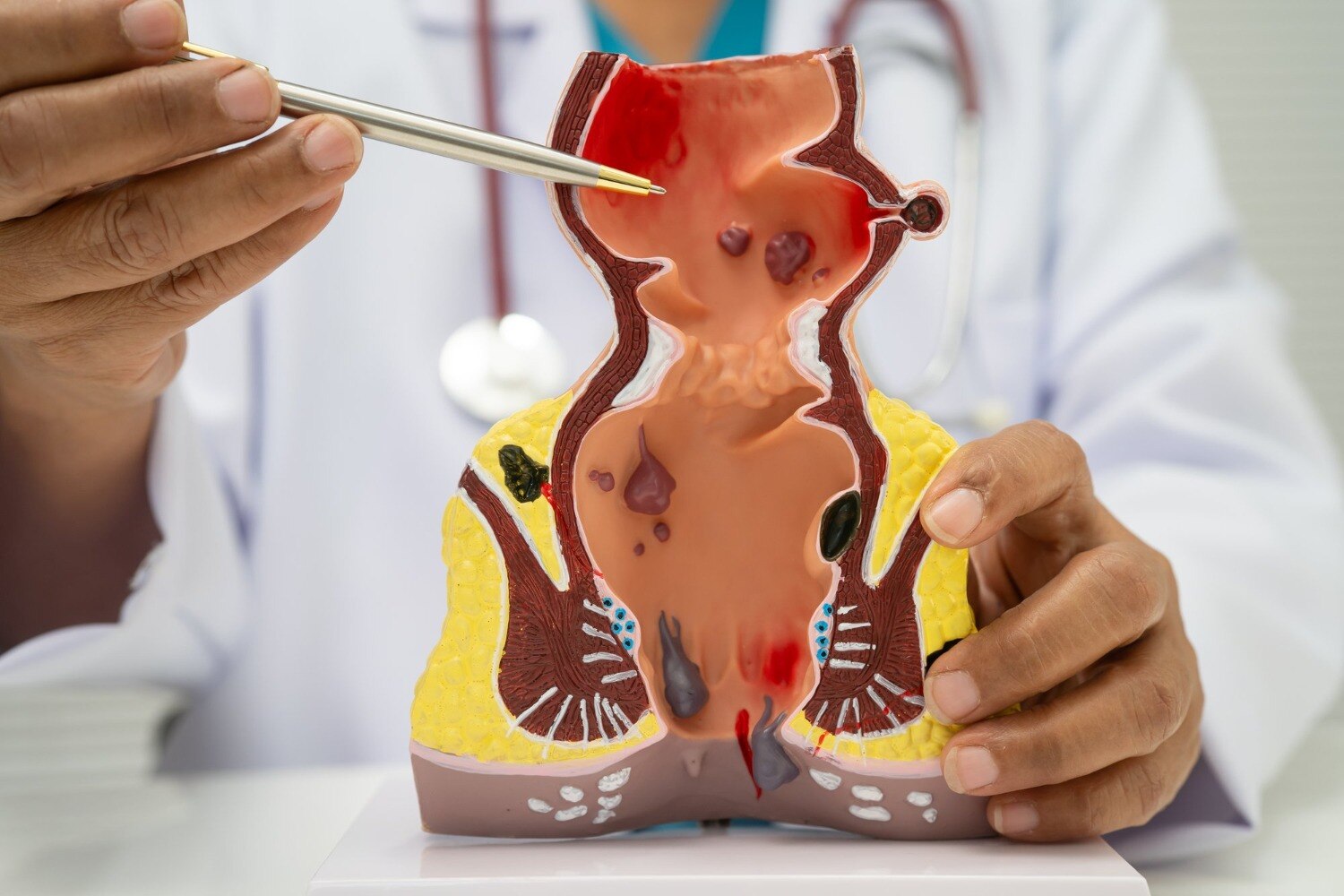
Rectal bleeding that returns, pain that lasts beyond a brief bowel movement, or symptoms that fail to improve after about a week of sensible self-care deserve medical assessment. You will be able to separate emergency warning signs from routine appointment symptoms, recognise patterns that point beyond haemorrhoids, and prepare for a focused consultation.
Key takeaways
- Seek emergency care for heavy bleeding, clots, black stool, fainting, or severe weakness.
- Persistent bleeding needs assessment because fissures, fistulas, polyps, and cancer can mimic haemorrhoids.
- A specialist may perform an inspection, digital rectal examination, anoscopy, or further testing.
- Use self-care briefly for mild symptoms; arrange review when pain or bleeding persists or returns.
Which pain and bleeding symptoms need emergency care?
Seek emergency care now; do not wait for a routine piles appointment. Heavy or nonstop bleeding, large clots, black or tarry stool, or maroon stool can signal dangerous blood loss. Fainting, marked dizziness, confusion, or weakness raises the same concern.
Severe pain that is rapidly worsening, fever or chills, increasing swelling, pus-like drainage, a painful lump that cannot be pushed back, or inability to pass stool or urine also needs urgent assessment.
Arrange a piles-specialist appointment when:
- Bleeding recurs, even intermittently; repeated episodes still count as persistent piles bleeding.
- Pain lasts beyond a short episode or interferes with normal activity.
- There is no clear improvement after about one week of appropriate self-care.
- You take anticoagulants, have immunosuppression, unexplained weight loss, or known anaemia; seek assessment sooner.
Rectal bleeding urgency depends on the pattern, but black stool and piles bleeding are not interchangeable descriptions. Use this guide:
| Symptom pattern | Action | Reason |
|---|---|---|
| Heavy bleeding, clots, black or maroon stool, fainting, confusion or severe weakness | Emergency care now | Possible dangerous blood loss |
| Rapidly worsening pain with fever, swelling or pus | Urgent assessment today | Possible perianal abscess |
| Painful irreducible lump or inability to pass stool or urine | Urgent assessment today | Possible obstruction or strangulation |
| Recurring bleeding or persistent piles pain without red flags | Specialist appointment | The cause may not be haemorrhoids |
| No improvement after one week of suitable self-care | Specialist appointment | Ongoing symptoms need examination |
Does the symptom pattern really fit haemorrhoids?
Uncomplicated internal haemorrhoids commonly cause painless, bright-red blood on toilet paper or on the stool surface. Haemorrhoids versus fissure becomes clearer from the pain pattern, but any recurrent bleeding deserves assessment rather than automatic labelling as piles.
| Pattern | What it may suggest | What to do |
|---|---|---|
| Sharp or burning pain during a bowel movement and for minutes or hours afterward, with a small amount of bright-red blood | Anal fissure | Discuss specialist treatment if symptoms last beyond about six weeks; this suggests a chronic fissure |
| Sudden, very painful lump at the anal margin | Thrombosed external haemorrhoid | Arrange prompt assessment |
| Painful lump that cannot be pushed back | Strangulated haemorrhoid | Seek urgent care |
| Severe pain with fever, swelling or pus | Perianal abscess symptoms | Seek urgent assessment; drainage usually treats it, while antibiotics alone are not enough |
| Ongoing anal fistula drainage from an opening, or repeated swelling after an abscess | Anal fistula | Arrange specialist assessment; medication alone rarely cures it |
| Diarrhoea, abdominal pain or urgency with bleeding | Inflammatory bowel disease rectal bleeding | Arrange broader bowel evaluation |
| Bleeding without obvious anal symptoms | Polyps | Ask a clinician whether bowel investigation is needed |
| Bleeding with altered bowel habits, weight loss, anaemia or a family history | Possible colorectal cancer | Arrange prompt evaluation |
Bleeding that returns, changes pattern or appears with fatigue should not be dismissed, even when it stops between episodes.
What will a specialist ask, examine and test?
Expect a focused history, not an assumption that every bleed is piles. Before the appointment, keep a dated symptom record and bring the names of every medicine, including aspirin and anticoagulants.
- Note when bleeding began, whether it recurs, its colour, and whether it appears on toilet paper, coats the stool, or is mixed into it. Estimate the amount.
- Record when pain occurs, bowel frequency and stool consistency, straining, prolapse, drainage, abdominal symptoms, weight loss, and treatments already tried.
- Note your pregnancy status and any personal or family history of bowel cancer or polyps.
A piles specialist examination may include inspection of the anal skin, a digital rectal examination and anoscopy or proctoscopy to view the anal canal. These can identify haemorrhoids, fissures, masses and fistula openings, but they do not rule out disease higher in the colon.
A complete blood count and iron studies can detect blood loss and iron-deficiency anaemia. Stool testing, flexible sigmoidoscopy or colonoscopy may be considered for persistent bleeding, anaemia, altered bowel habits, weight loss, screening age, or a personal or family history of bowel cancer or polyps.
Bring photographs only if a clinician requests them; do not feel obliged to take them yourself.
When is self-care enough, and when is a procedure considered?
A short trial of conservative piles treatment suits mild, uncomplicated symptoms: add fibre-rich food or a fibre supplement gradually, drink adequate fluids, use stool-softening measures when advised, avoid straining and long toilet sitting, and take warm sitz baths. If bleeding or pain persists, arrange examination rather than extending self-care indefinitely.
| Option | Main trade-off | When it applies |
|---|---|---|
| Prescription treatment | Less invasive, but needs correct diagnosis and repeated use | Selected fissures may respond to creams, nitroglycerin or calcium-channel blockers |
| Office procedure | Usually quicker recovery, but recurrence and follow-up remain possible | Rubber-band ligation, sclerotherapy or infrared coagulation suit many grade I–II and selected grade III internal haemorrhoids |
| Fissure procedure | Botulinum toxin avoids sphincter division; sphincterotomy is highly effective but carries continence risk | Chronic fissures after medical treatment; review continence history before lateral internal sphincterotomy |
| Operation | More postoperative pain, recovery time and bowel-care demands, but addresses bulky disease | Large external components or combined internal/external grade III–IV disease may favour haemorrhoidectomy or another operation |
| Laser | Recovery and recurrence depend on the haemorrhoid pattern, not the word “laser” | Laser piles treatment suitability concerns selected internal haemorrhoids, not every painful lump |
Haemorrhoidectomy versus laser is therefore a clinical comparison, not a default choice. External disease, thrombosis, fissure or abscess may need another approach.
Consultation covers examination, preparation, anaesthesia, expected time away from work and warning signs afterward; Dr Gowri Singh-Best Laser Piles Surgeon in Pune can compare these options during an evaluation rather than selecting laser automatically.
Related services
Laser Piles Surgeon in Pune Laser Piles Surgeon in Viman Nagar, Kharadi, Vishrantwadi, Pune Dr Gowri Singh is the Best Laser Piles Surgeon in Pune, specializing as a Piles Surgeon, Laser Piles Doctor, and Lady Piles Surgeon in Viman Nagar,... View service → |
Piles Doctor in Pune Piles Doctor in Viman Nagar, Kharadi, Vishrantwadi, Pune Dr Gowri Singh is the Best Piles Doctor, Laser Piles Surgeon, Laser Piles Doctor, Lady Piles Doctor in Viman Nagar, Kalyani Nagar, Koregaon Park,... View service → |
What mistakes delay the right diagnosis?
Stop treating every bright-red bleed as piles. Blood mixed through stool, altered bowel habits, abdominal symptoms, weight loss or fatigue needs broader assessment for bowel disease, polyps or cancer.
While arranging care, avoid these mistakes with piles treatment:
- Do not repeatedly use steroid or numbing creams without review. Steroid cream piles risks include skin damage, symptom masking and prolonged unsuitable treatment.
- Do not insert objects or suppositories if a fissure or abscess is possible, and never squeeze a lump or try to drain it.
- Avoid straining and prolonged toilet sitting. Do not postpone assessment simply because bleeding stops between episodes.
- Arrange early review for a sudden, very painful lump at the anal margin. A thrombosed external haemorrhoid may get faster relief when selected treatment is considered within roughly 72 hours.
- Treat ongoing drainage or recurrent swelling as a reason for assessment: a fistula usually does not heal reliably with medication alone.
- Discuss chronic anal fissure treatment when sharp or burning pain and bleeding continue beyond six weeks instead of repeating self-care.
Seek emergency care for heavy or nonstop bleeding, large clots, black or maroon stool, fainting, severe weakness, worsening pain, fever, pus, an irreducible lump, or inability to pass stool or urine. Book a routine assessment for recurring or unresolved symptoms, and take your symptom diary and medication list.
Frequently asked questions
Which piles symptoms require emergency care?
Seek emergency care for heavy or nonstop bleeding, large clots, black or tarry stool, maroon stool, fainting, marked dizziness, confusion, or severe weakness.
How can you tell whether symptoms are really haemorrhoids?
Bright-red bleeding and anal discomfort can occur with haemorrhoids, but fissures, fistulas, polyps, inflammatory bowel disease, and bowel cancer can cause similar symptoms. Persistent or recurrent symptoms need assessment.
What happens during a piles specialist consultation?
The specialist asks about bleeding, pain, bowel habits, medicines, and previous conditions, then examines the anus and rectum. They may use anoscopy or order further tests when the findings require it.
When is self-care enough for piles?
Short-term self-care can suit mild symptoms that improve with softer stools, fibre, fluids, and avoiding straining. Arrange specialist review when pain or bleeding persists, returns, or worsens.
What mistakes delay the correct diagnosis?
Assuming every episode of rectal bleeding is piles, using steroid creams for too long, straining on the toilet, and postponing assessment of recurrent symptoms can delay diagnosis and treatment.